

7 Drucker Prager
The Drucker-Prager material is very similar to the Mohr-Coulomb material but uses slightly different expressions for the yield and plastic potential function.
7.1 Summary of material parameters
The key material parameters are summarized below. More specialized parameters are elaborated on in later sections.
Stiffness
-
E: Young's modulus
-
\nu: Poisson's ratio
Strength
-
k: cohesion
-
M: friction coefficient
7.2 Governing equations
7.2.1 Elasticity
Isotropic elasticity defined by E and \nu is used (see Elasticity).
7.2.2 Failure surface
The Drucker-Prager failure surface is given by
F = q-Mp'-k \tag{7.1}where k and M are the cohesion and friction coefficient respectively.
The Drucker-Prager failure surface depicts a regular cone in three-dimensional stress space as shown in Figure 7.1.
7.2.3 Flow rule
The flow potential is given by
G = q-Np' \tag{7.2}where M is the dilation coefficient.
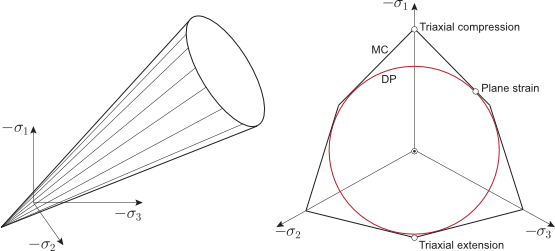
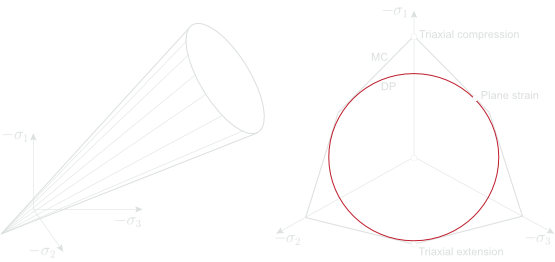
Figure 7.1: Drucker-Prager failure surface (left) and inner Drucker-Prager approximation to Mohr-Coulomb (right).
For Flow Rule = Nonassociated, the same choices regarding dilation cap as for the Mohr-Coulomb model are available.
7.2.4 Drucker-Prager versus Mohr-Coulomb
An inner Drucker-Prager approximation of the Mohr-Coulomb failure surface (see Figure 7.1) is achieved by setting:
M= \frac{3 \sin\phi'}{\sqrt{3+\sin^2\phi'}},~~~
k = \frac{3 c'\cos\phi'}{\sqrt{3+\sin^2\phi'}} \tag{7.3}
This approximation matches the Mohr-Coulomb criterion exactly for the special case of plane strain with \psi=\phi.